- Module 1: Introduction to Financial Accounting
- 1.1 Financial Accounting
- 1.2 Recording of Transactions
- Full Worked Example — Journal Entry and Ledger Posting (verbatim course illustration, Lesson 1.2.6)
- Full Worked Example — Preparation of a Trial Balance (verbatim course illustration, Lesson 1.2.9)
- Quick Revision — Definitions to memorise
- Module Summary (from the SCORM course's own end-of-module recap, Lesson 20)
- Glossary (from the SCORM course, Lesson 21)
- Self-Study Exercise & Activity Prompts (Lessons 23-24, for practice — attempt in your notebook)
- Full Worked Example 1: Journalising Transactions (classic exam problem)
- Full Worked Example 2: Ledger Posting + Trial Balance (continuing from Example 1)
- Full Worked Example 3: Suspense Account (when a Trial Balance doesn't tally)
- Long-Answer Questions (15 Marks — model answers, ~300 words each)
Module 1: Introduction to Financial Accounting
(Accounting for Managers – ACCT602, Semester I)
✅ Verified against the live AMIGO course — fully completed in-LMS (25/25 lessons + 100% Module Assessment), and this Notes file has been walked back through in SCORM "review mode" to fold in real lecture/reading-page content (not just the PDF) — look for the ✅ callouts below.
1.1 Financial Accounting
Business (per the course): an economic activity conducted to earn profits and increase the wealth of the owner, governed by general principles of trade, social values, and the applicable legal framework — the basic goal is always to add value to a product/service to satisfy customer demand.
Financial Accounting = art & science of recording, classifying, summarising and reporting business transactions to determine profit/loss and financial position.
✅ Verified against the live course (Lesson 1.1.1): Accounting is described as "the language of business" — through reporting all transactions related to monetary inflows (sales revenue) and outflows (operating expenses), the accounting system ensures accountability, lets stakeholders assess the efficacy of current/past activities, and provides the data needed to report on a business's liabilities, ownership equities, and asset capital. Its three key functions: recording, classifying, and summarising.
Three Branches of Accounting
| Type | Purpose | Users |
|---|---|---|
| Financial Accounting | Profit/loss + assets/liabilities for the year | External (shareholders, creditors) |
| Cost Accounting | Cost of production per unit/process | Internal + cost control |
| Management Accounting | Info for planning, controlling, decision-making | Internal management only |
Exam tip — Financial vs Management Accounting (favourite question):
| Basis | Financial Accounting | Management Accounting |
|---|---|---|
| Base | Monetary transactions | Data from financial accounting |
| Users | Shareholders, creditors, management | Management only |
| Audit | Statutory audit required | No statutory audit |
| Data | Objective | Objective + subjective |
| Scope | Whole business | Sectional + whole |
Objectives of Accounting
- Systematic record-keeping
- Ascertain profitability (P&L A/c)
- Ascertain financial position (Balance Sheet)
- Aid decision-making
- Ensure legal/tax compliance
Accounting Standards — Ind AS vs US GAAP vs IFRS
| Ind AS | US GAAP | IFRS | |
|---|---|---|---|
| Regulator | ICAI | FASB | IASB |
| Basis | Converged with IFRS (with carve-outs) | Rule-based | Principle-based |
| Applies in | India | USA | Adopted globally (esp. Europe) |
Accounting Cycle (sequence — very commonly asked)
flowchart TD
    A[Business Transaction Occurs] --> B[Subsidiary Books]
    B --> C[Journal - chronological entry]
    C --> D[Ledger - posting by account]
    D --> E[Trial Balance]
    E --> F[Adjustment Entries]
    F --> G[Adjusted Trial Balance]
    G --> H[Closing Entries]
    H --> I[Financial Statements: P&L + Balance Sheet]
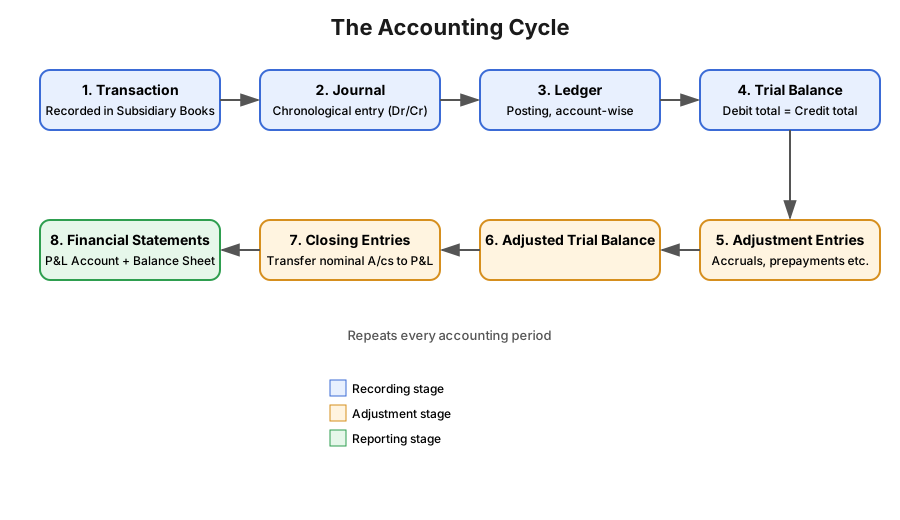
🧠 Memory trick: "Just Prepare The Adjustments, After That, Finally Close" → Journal → Post (Ledger) → Trial Balance → Adjustments → Adjusted TB → Financial Statements → Closing Entries.
1.2 Recording of Transactions
Accounting Equation
Assets = Liabilities + Capital (A = L + P) Expanded: Assets = Liabilities + Capital + Revenue − Expenses Profit = Revenue − Expenses
- Increase in capital → assets increase correspondingly.
- Every transaction keeps both sides equal (basis of double-entry).
Rules of Debit and Credit — Golden Rules (traditional/English approach)
| Account Type | Rule |
|---|---|
| Personal A/c | Debit the Receiver, Credit the Giver |
| Real A/c | Debit what comes in, Credit what goes out |
| Nominal A/c | Debit all expenses/losses, Credit all incomes/gains |
The 5 Account Categories (from SCORM lesson accordion, 1.2.3)
| Category | Definition |
|---|---|
| Assets | Business's properties/resources (tangible or intangible); split into Fixed (long-term) and Current (short-term) assets. |
| Liabilities | Amounts owed to outsiders; split into Long-term (e.g. debentures, bank loans, payable after 1 yr) and Current (e.g. creditors, bills payable, payable within 1 yr). |
| Capital | Cash/property brought in by the owner (Owner's Equity); shown on the liabilities side of the Balance Sheet, net of Drawings (cash/goods the owner withdraws for personal use). |
| Revenue | Amount earned from selling goods/services, plus other income (rent, commission, interest, dividend received). |
| Expenses | Costs incurred to earn revenue; if the benefit is exhausted within a year it's an expense, if it lasts beyond a year it's capitalised as an investment/asset instead. |
Modern (Equation) Approach
| Account | Debit when | Credit when | Normal Balance |
|---|---|---|---|
| Asset | Increase | Decrease | Debit |
| Liability | Decrease | Increase | Credit |
| Capital | Decrease | Increase | Credit |
| Revenue | Decrease | Increase | Credit |
| Expense/Drawings | Increase | Decrease | Debit |
flowchart LR
    subgraph Increase_is_Debit
    Asset
    Expense
    Drawings
    end
    subgraph Increase_is_Credit
    Liability
    Capital
    Revenue
    end
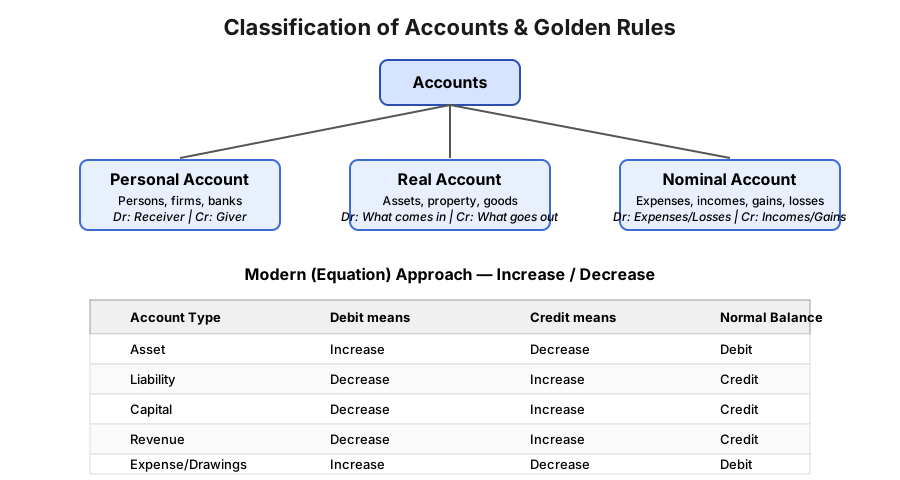
🧠 Memory trick — "DEAD CLIC": things that increase on the DEBIT side = Drawings, Expenses, Assets, Depreciation. Things that increase on the CREDIT side = Capital, Liabilities, Income, Collections (Revenue). If it's DEAD, it's Debited; if it CLICks, it's Credited.
🧠 Golden Rules trick: Personal → "Debit the Receiver, Credit the Giver" (think: a person receives into their hand = debit). Real → "Debit what Comes in, Credit what Goes out" (like a door — IN=debit, OUT=credit). Nominal → "Debit Expenses/Losses, Credit Incomes/Gains" (expenses hurt = debit; gains help = credit).
Journal → Ledger → Trial Balance
- Journal: book of original/first entry; chronological; each entry has a narration starting with "Being...".
- Functions: Analytical, Recording, Historical.
- Ledger: "King of all books" / Book of Final Entry — transactions grouped account-wise (posting). Left = Debit, Right = Credit.
- Journal vs Ledger (common 5-marker):
| Basis | Journal | Ledger |
|---|---|---|
| Nature | First/original entry | Final entry |
| Record | Chronological | Account-wise (analytical) |
| Process name | Journalising | Posting |
| Legal weight | Higher (source document) | Lower |
Full Worked Example — Journal Entry and Ledger Posting (verbatim course illustration, Lesson 1.2.6)
Problem: On 1st April, Mohit started business with a capital of ₹50,000. He made the following transactions:
| Date | Particular | ₹ |
|---|---|---|
| April 3 | Purchased goods from Rita on credit | 20,000 |
| April 4 | Cash paid to Rita | 10,000 |
| April 6 | Goods sold to Rohit on credit | 25,000 |
| April 8 | Received cash from Rohit | 20,000 |
| April 12 | Goods purchased from Rita | 12,000 |
| April 18 | Cash paid to Rita | 20,000 |
| April 25 | Goods sold to Rohit | 10,000 |
| April 30 | Received cash from Rohit | 6,000 |
Journal:
| Date | Particular | Dr. (₹) | Cr. (₹) |
|---|---|---|---|
| April 1 | Cash A/c Dr. To Capital A/c (Being commenced business with cash) | 50,000 | 50,000 |
| April 3 | Purchase A/c Dr. To Rita A/c (Being goods purchase on credit) | 20,000 | 20,000 |
| April 4 | Rita A/c Dr. To Cash A/c (Being paid to Rita) | 10,000 | 10,000 |
| April 6 | Rohit A/c Dr. To Sales A/c (Being goods sold to Rohit on credit) | 25,000 | 25,000 |
| April 8 | Cash A/c Dr. To Rohit A/c | 20,000 | 20,000 |
| April 12 | Purchase A/c Dr. To Rita A/c (Being goods purchase on credit) | 12,000 | 12,000 |
| April 18 | Rita A/c Dr. To Cash A/c (Being paid to Rita) | 20,000 | 20,000 |
| April 25 | Rohit A/c Dr. To Sales A/c (Being goods sold to Rohit) | 10,000 | 10,000 |
| April 30 | Cash A/c Dr. To Rohit A/c (Being cash received from Rohit) | 6,000 | 6,000 |
Ledger Postings (key accounts): - Cash A/c: Dr side (To Capital 50,000 + To Rohit's A/c 20,000 + To Rohit's A/c 6,000 = 76,000) vs Cr side (By Rita's A/c 10,000 + By Rita's A/c 20,000 + By Balance c/d 46,000 = 76,000) → Closing balance ₹46,000 carried down as "To Balance b/d" on 1 May. - Capital A/c: Cr side By Cash 50,000 → balanced by "To Balance c/d 50,000", carried forward as "By Balance b/d ₹50,000". - Purchase A/c: Dr side To Rita's A/c 20,000 + 12,000 = ₹32,000, carried forward as "To Balance b/d 32,000". - Rita's A/c: Dr side (To Cash 10,000 + To Cash 20,000 + To Balance c/d 2,000 = 32,000) vs Cr side (By Purchase A/c 20,000 + By Purchase A/c 12,000 = 32,000) → Rita is still owed ₹2,000.
(This example is the standard exam pattern — practice extending it to Sales A/c and Rohit's A/c yourself: Sales A/c should total ₹35,000 credit, and Rohit's A/c should show a ₹9,000 debit balance still receivable.)
Subsidiary Books (special journals — used when transaction volume is high)
Cash Book · Purchases Book · Sales Book · Purchases Return Book · Sales Return Book · Bills Receivable Book · Bills Payable Book · Journal Proper (for items not fitting elsewhere)
✅ Verified against the live course (Lesson 1.2.7) — why subsidiary books exist: recording every transaction in one single Journal becomes impractical for a large business because (1) the system requires re-writing the account name for every occurrence plus a separate posting for each debit/credit — highly repetitive; (2) information isn't available promptly; (3) the journal becomes bulky and voluminous; (4) a single journal can't support an internal check system (it can only be managed by one person). Subsidiary books solve this by splitting transactions into special journals — one book per category of repetitive, similar, and numerous transactions.
Trial Balance
- A list of all ledger account balances (Debit column vs Credit column) at a point in time.
- Purpose: checks arithmetical accuracy; base for final accounts.
- Debit total = Credit total if books are arithmetically correct — but this does NOT guarantee zero errors.
✅ Verified against the live course (Lesson 1.2.8) — 5 Features of a Trial Balance: (1) it's a list of debit and credit balances extracted from various ledger accounts; (2) it serves as a statement of debit and credit balances; (3) its primary purpose is to verify arithmetical accuracy of transactions recorded in the Books of Accounts; (4) typically prepared at year-end, but can also be done weekly/monthly/quarterly/semi-annually; (5) it acts as a link between the books of accounts and the P&L Account/Balance Sheet.
4 Purposes of a Trial Balance (from the course): to verify arithmetical accuracy of recorded transactions; to ascertain the balance of any ledger account; to serve as evidence that double-entry bookkeeping has been completed for every transaction; to facilitate the prompt preparation of final accounts.
Errors NOT disclosed by Trial Balance (important MCQ/short-answer area) — the course teaches 6 types: 1. Error of Omission – transaction not recorded at all 2. Error of Commission – posted to wrong account, correct side 3. Error of Subsidiary Books – the wrong amount is entered in the subsidiary book itself (so it flows through correctly balanced but wrong) 4. Error of Principle – capital/revenue item misclassified (course's own example: debiting the purchase of a tractor to an Expense A/c instead of correctly to a Fixed Assets A/c — the trial balance total is unaffected either way) 5. Compensating Errors – excess-debit/under-debit of one account neutralised by excess-credit/under-credit of the same extent in another account 6. Compensatory Errors – errors on one side of a ledger account compensated by errors of the same amount on the other side (or the same side) — a closely related variant of #5 in the course's own framing
🧠 Memory trick — "OPCC": Omission, Principle, Commission, Compensating — the core 4 error types a Trial Balance can NEVER catch (add Subsidiary Books + Compensatory as the course's 2 extra nuanced variants), because in each case debits still equal credits.
- Suspense Account: temporary account to hold the difference when a trial balance doesn't tally, until the error is located. ✅ Course's own definition: "When the Trial Balance does not tally, efforts are made to make the trial balance tally. However, if the efforts fail, then temporarily the difference of Trial Balance is transferred to an account known as the Suspense Account."
Full Worked Example — Preparation of a Trial Balance (verbatim course illustration, Lesson 1.2.9)
Problem: From the following ledger account balances, prepare a Trial Balance of Mr. Tom for the year ended 31st March 2016: Capital ₹80,000; Sales ₹10,00,000; Adjusted Purchase ₹8,00,000; Current A/c (Cr) ₹10,000; Petty Cash ₹10,000; Sales Ledger Balance ₹1,20,000; Purchase Ledger Balance ₹60,000; Salaries ₹24,000; Carriage Inward ₹4,000; Carriage Outward ₹6,000; Discount Allowed ₹10,000; Building ₹80,000; Outstanding Expenses ₹10,000; Prepaid Insurance ₹2,000; Depreciation ₹4,000; Cash at Bank ₹80,000; Loan A/c (Cr) ₹66,000; Profit & Loss A/c (Cr) ₹20,000; Bad Debts Recovered ₹2,000; Stock at 31.03.2016 ₹1,20,000; Interest Received ₹10,000; Accrued Interest ₹4,000; Investment ₹20,000; Provision for Bad Debts (01.04.2015) ₹6,000; General Reserve ₹20,000.
Solution:
| Debit Balances | ₹ | Credit Balances | ₹ |
|---|---|---|---|
| Adjusted Purchase | 8,00,000 | Capital | 80,000 |
| Petty Cash | 10,000 | Sales | 10,00,000 |
| Sales Ledger Balance | 1,20,000 | Current A/c | 10,000 |
| Salaries | 24,000 | Purchase Ledger Balance | 60,000 |
| Carriage Inward | 4,000 | Outstanding Expenses | 10,000 |
| Discount Allowed | 10,000 | Loan A/c | 66,000 |
| Building | 80,000 | Profit & Loss A/c | 20,000 |
| Prepaid Insurance | 2,000 | Bad Debts Recovered | 2,000 |
| Depreciation | 4,000 | Interest Received | 10,000 |
| Cash at Bank | 80,000 | Provision for Bad Debts | 6,000 |
| Stock (31.03.2016) | 1,20,000 | General Reserve | 20,000 |
| Accrued Interest | 4,000 | ||
| Investment | 20,000 | ||
| Carriage Outward | 6,000 | ||
| Total | 12,84,000 | Total | 12,84,000 |
Key rule from this example: "Closing Stock will appear in the Trial Balance since there is Adjusted Purchase." Normally Closing Stock does NOT appear in a trial balance (it's an adjustment shown outside) — but when the question already nets it into an "Adjusted Purchase" figure (Adjusted Purchase = Opening Stock + Purchases − Closing Stock), the Closing Stock must then be separately re-introduced as an asset in the trial balance itself, since it was "used up" inside the adjusted purchase calculation.
Accounting Concepts vs Conventions — Quick Recall
🧠 6 Concepts — "Big Money Goes Around, Matching Duals": Business Entity, Money Measurement, Going Concern, Accrual, Matching, Dual Aspect.
🧠 4 Conventions — "Come Conserve Material Disclosures": Consistency, Conservatism (Prudence), Materiality, Disclosure (Full Disclosure).
One-line distinction (frequently asked): Concepts are the foundational assumptions that make double-entry accounting logically work (e.g. Dual Aspect); Conventions are practical customs adopted for sensible, comparable reporting (e.g. Conservatism). See Q5 below for full explanations with examples.
✅ Real-world case study from the course (Lesson 1.1.5) — Molson Coors Brewing Company (2005-2013): the course uses Molson Coors' actual financial statements (formed via the 2005 Adolph Coors/Molson Inc. merger) to teach income-statement concepts in context. Notable real-world nuances covered: - Sales vs Net Sales are NOT interchangeable: for Molson Coors, "Sales" = revenue from beer/malt beverages before deducting excise taxes (a government-imposed indirect tax on the shipped product); "Net Sales" = Sales minus those excise taxes. Reporting both separately lets users trend-analyse the tax impact on revenue over time — a useful real illustration of why income statements sometimes show more than one "top line" figure. - "Special Items, net": a separate income-statement line item (permitted under FASB ASU 2015-01) for charges/benefits not indicative of core operations — e.g. impairment losses, restructuring charges, atypical employee-termination costs, gains/losses on disposal of investments. Classifying these separately (rather than burying them in ordinary expenses) helps users judge a company's earnings persistence — i.e. which profits are likely to recur vs which were one-off. - Comprehensive Income ≠ Net Income: Comprehensive Income includes Net Income plus items like unrealised gains/losses on investments, retirement-plan adjustments, and foreign-currency translation adjustments — capturing everything that changed shareholders' equity over the period, not just the P&L result.
Quick Revision — Definitions to memorise
- Accrual basis: expense/income recorded when incurred/earned, not when cash moves.
- Double-entry system: every transaction affects ≥2 accounts; total debits = total credits.
- Liability: probable future sacrifice of economic benefit from a past transaction.
- Journal narration: brief explanation starting with "Being...".
Module Summary (from the SCORM course's own end-of-module recap, Lesson 20)
- Financial accounting aims to identify an accounting year's results — profit/loss and assets/liabilities — by systematically documenting transactions.
- Financial accounting is the art & science of classifying, analysing, and reporting business transactions to prepare a year-end report.
- The Profit & Loss Account and the Balance Sheet together are called the Final Accounts — P&L shows financial results, Balance Sheet shows financial position.
- Accurate financial records require correctly recognising revenues and expenses — distinguishing capital items from revenue items is crucial to getting profit/loss right.
- ICAI created Ind AS to promote consistency and transparency; through convergence, Ind AS and IFRS have become closely aligned.
- Recording transactions is likened to an artist's brushstrokes — each transaction is a "stroke" that together builds the "masterpiece" (the financial statements).
- The Journal lists an enterprise's transactions (other than pure cash-only entries in simplified systems) before they are posted to ledgers — today used mainly for non-routine/adjustment entries once subsidiary books exist.
- The Ledger is a book of records where all of a business's accounts are entered in summarised, classified form.
Glossary (from the SCORM course, Lesson 21)
| Term | Definition |
|---|---|
| Ind AS | Accounting standards adopted by ICAI to ensure consistency and transparency in Indian financial reporting. |
| Double Entry System | Bookkeeping method where every transaction has equal and opposite effects on at least two accounts, keeping records balanced. |
| Ledger | A record-keeping book containing all the accounts used by a company, showing debits and credits in each. |
| Journal | The book where transactions are first recorded chronologically, before being posted to the ledger. |
| Final Accounts | The financial statements of a business — P&L Account (income statement) and Balance Sheet — summarising performance and position at period-end. |
🧠 Memory trick for the Glossary: "I Debate Like Judges, Finally" → Ind AS, Double Entry, Ledger, Journal, Final Accounts.
Self-Study Exercise & Activity Prompts (Lessons 23-24, for practice — attempt in your notebook)
- What are the functions of Business Accounting?
- Explain the categories of Accounting.
- Difference between Indian, US, and International Accounting Standards.
- (activity) Take a case study of a business with various transactions — analyse them, identify the relevant accounting principles, and prepare a Trial Balance / simple financial statement.
- How do you prepare a Trial Balance? — walk through it step by step using a sample set of ledger balances.
Full Worked Example 1: Journalising Transactions (classic exam problem)
Problem: Journalise the following transactions in the books of Mr. Verma for April 2026.
| Date | Transaction |
|---|---|
| Apr 1 | Started business with cash ₹1,00,000 |
| Apr 3 | Purchased goods for cash ₹30,000 |
| Apr 5 | Purchased goods from Ramesh on credit ₹20,000 |
| Apr 8 | Sold goods for cash ₹25,000 |
| Apr 10 | Sold goods to Suresh on credit ₹18,000 |
| Apr 15 | Paid rent ₹5,000 |
| Apr 18 | Received commission ₹2,000 |
| Apr 20 | Paid Ramesh ₹15,000 on account |
| Apr 25 | Suresh paid ₹10,000 on account |
| Apr 30 | Withdrew cash for personal use ₹4,000 |
Solution (Journal):
| Date | Particulars | L.F. | Debit (₹) | Credit (₹) |
|---|---|---|---|---|
| Apr 1 | Cash A/c Dr. | 1,00,000 | ||
| To Capital A/c | 1,00,000 | |||
| (Being business started with cash) | ||||
| Apr 3 | Purchases A/c Dr. | 30,000 | ||
| To Cash A/c | 30,000 | |||
| (Being goods purchased for cash) | ||||
| Apr 5 | Purchases A/c Dr. | 20,000 | ||
| To Ramesh A/c | 20,000 | |||
| (Being goods purchased from Ramesh on credit) | ||||
| Apr 8 | Cash A/c Dr. | 25,000 | ||
| To Sales A/c | 25,000 | |||
| (Being goods sold for cash) | ||||
| Apr 10 | Suresh A/c Dr. | 18,000 | ||
| To Sales A/c | 18,000 | |||
| (Being goods sold to Suresh on credit) | ||||
| Apr 15 | Rent A/c Dr. | 5,000 | ||
| To Cash A/c | 5,000 | |||
| (Being rent paid) | ||||
| Apr 18 | Cash A/c Dr. | 2,000 | ||
| To Commission Received A/c | 2,000 | |||
| (Being commission received) | ||||
| Apr 20 | Ramesh A/c Dr. | 15,000 | ||
| To Cash A/c | 15,000 | |||
| (Being cash paid to Ramesh on account) | ||||
| Apr 25 | Cash A/c Dr. | 10,000 | ||
| To Suresh A/c | 10,000 | |||
| (Being cash received from Suresh on account) | ||||
| Apr 30 | Drawings A/c Dr. | 4,000 | ||
| To Cash A/c | 4,000 | |||
| (Being cash withdrawn for personal use) | ||||
| Total | 2,29,000 | 2,29,000 |
How to think through each line (the exam technique): for every transaction, ask (1) which two accounts are affected? (2) which type is each — Personal, Real, or Nominal? (3) apply the Golden Rule for each type. E.g. Apr 5: Purchases (Real — comes in → Debit) and Ramesh (Personal — the giver → Credit). Apr 18: Cash (Real — comes in → Debit) and Commission Received (Nominal — income/gain → Credit).
Full Worked Example 2: Ledger Posting + Trial Balance (continuing from Example 1)
Posting the journal above into ledger accounts and balancing each gives these closing balances:
| Account | Debit Balance (₹) | Credit Balance (₹) |
|---|---|---|
| Cash A/c | 83,000 | |
| Capital A/c | 1,00,000 | |
| Purchases A/c | 50,000 | |
| Ramesh A/c | 5,000 | |
| Sales A/c | 43,000 | |
| Suresh A/c | 8,000 | |
| Rent A/c | 5,000 | |
| Commission Received A/c | 2,000 | |
| Drawings A/c | 4,000 | |
| Total | 1,50,000 | 1,50,000 |
(Working for Cash A/c: 1,00,000 + 25,000 + 2,000 + 10,000 − 30,000 − 5,000 − 15,000 − 4,000 = 83,000. Working for Ramesh: 20,000 owed − 15,000 paid = 5,000 still owed. Working for Suresh: 18,000 owed − 10,000 received = 8,000 still owed. Working for Sales: 25,000 + 18,000 = 43,000.)
Since Debit Total = Credit Total = ₹1,50,000, the Trial Balance tallies, confirming the ledger postings are arithmetically correct (though, per the OPCC rule above, this alone doesn't prove there are zero errors).
Exam shortcut for building a Trial Balance fast: Assets + Expenses + Drawings + Losses always go in the Debit column; Liabilities + Capital + Revenue + Income + Gains always go in the Credit column — you never need to re-derive the Golden Rules at this stage, just classify each ledger account once and slot it in.
Full Worked Example 3: Suspense Account (when a Trial Balance doesn't tally)
Problem: A trial balance shows a difference of ₹500 (credit side short). On checking, it's found that a credit sale of ₹500 to Mohan was correctly entered in the Sales Book but never posted to Mohan's account. Solution: Open a Suspense A/c with the ₹500 difference. Since Mohan's account (a personal account, should have been debited ₹500) was never posted, correct it: Mohan A/c Dr. ₹500, To Suspense A/c ₹500. Once posted, the Suspense A/c balance becomes zero and the trial balance is fully reconciled. (Note: only one-sided errors like this — where one account was missed entirely — go through Suspense A/c; two-sided errors like Errors of Principle or Compensating Errors don't touch Suspense A/c at all, since they don't cause a trial balance mismatch in the first place.)
Long-Answer Questions (15 Marks — model answers, ~300 words each)
Q1. Explain the Accounting Cycle in detail with its stages. The Accounting Cycle is the step-by-step sequence an organisation follows to identify, record, and report its financial transactions within an accounting period. It begins the moment a business transaction occurs — a documented, measurable event like a sale, purchase, or payment. Where transaction volume is high, entries are first grouped into Subsidiary Books (Cash Book, Purchases Book, Sales Book, etc.) to keep the main Journal manageable. Every transaction is then recorded chronologically in the Journal, the "book of original entry," with a narration explaining the transaction. Next comes Ledger posting, where each journal entry is transferred account-wise into the Ledger — the "book of final entry" — so that all transactions affecting a single account (e.g., Cash, Sales, Rent) appear together. Once a period ends, every ledger account is balanced and these balances are extracted into a Trial Balance, which checks that total debits equal total credits, confirming the arithmetical accuracy of the double-entry postings (though it cannot catch every type of error). Before final statements can be prepared, Adjustment Entries are passed — for outstanding expenses, prepaid expenses, accrued income, depreciation, and closing stock — so that the accounts reflect the correct period under the accrual concept. These adjustments are incorporated into an Adjusted Trial Balance. Closing Entries are then passed to transfer all nominal (revenue and expense) account balances into the Trading and Profit & Loss Account, resetting them to zero for the next period, while real and personal accounts are carried forward. Finally, the Financial Statements — the Trading and Profit & Loss Account (showing net profit/loss) and the Balance Sheet (showing financial position: assets, liabilities, and capital) — are prepared. This cycle repeats every accounting period, forming the backbone of systematic financial reporting and ensuring that a business's performance and position can be reliably measured, audited, and compared over time.
Q2. Distinguish between Financial Accounting and Management Accounting. Financial Accounting and Management Accounting are the two principal branches of accounting, differing chiefly in purpose, audience, and regulation. Financial Accounting is concerned with recording, classifying, and summarising a business's monetary transactions to determine its profit or loss for a period and its financial position at a point in time. Its output — the Trading and P&L Account and the Balance Sheet — is prepared primarily for external stakeholders: shareholders, creditors, banks, government, and the investing public. Because outsiders rely on it, Financial Accounting must follow statutory formats, is governed by Accounting Standards (Ind AS/IFRS/US GAAP), and is subject to mandatory statutory audit. Its data is largely objective and historical, covering the whole enterprise for a defined period (usually a financial year), and once published it typically cannot be altered. Management Accounting, in contrast, uses financial accounting data (plus additional operational, cost, and forecast information) to help internal management plan, control, and make decisions — such as pricing, budgeting, make-or-buy choices, and performance evaluation. It is intended solely for internal use, so there is no statutory audit requirement and no fixed format — reports can be as frequent and customised as management needs (daily, weekly, project-wise). Its data blends objective figures with subjective estimates and forward-looking projections (budgets, standard costs), and its scope can be as narrow as a single department or product line, unlike Financial Accounting's whole-business view. In short: Financial Accounting looks backward and outward (compliance-driven, historical, statutory), while Management Accounting looks forward and inward (decision-driven, flexible, discretionary) — together they give an organisation both accountability to the outside world and the insight needed to run itself effectively.
Q3. State and explain the Golden Rules of Accounting with suitable examples. The Golden Rules (also called the Traditional or English Approach) provide the foundation for deciding which account to debit and which to credit under the double-entry system. Accounts are first classified into three types — Personal, Real, and Nominal — and each type follows its own rule. (1) Personal Accounts relate to persons, firms, or organisations (e.g., a debtor, a creditor, a bank). The rule is "Debit the Receiver, Credit the Giver." Example: if goods are sold on credit to Mr. Ram, Ram's account (the receiver of goods) is debited, and Sales account is credited. (2) Real Accounts relate to assets and properties, whether tangible (machinery, cash, furniture) or intangible (goodwill, patents). The rule is "Debit what Comes In, Credit what Goes Out." Example: when a business purchases furniture for cash, Furniture A/c (coming in) is debited and Cash A/c (going out) is credited. (3) Nominal Accounts relate to expenses, losses, incomes, and gains (e.g., Rent, Salaries, Commission Received). The rule is "Debit all Expenses and Losses, Credit all Incomes and Gains." Example: paying ₹5,000 rent means Rent A/c (an expense) is debited and Cash A/c is credited; receiving ₹2,000 commission means Cash A/c is debited and Commission Received A/c (an income) is credited. These three rules ensure that every transaction is recorded with equal debit and credit effects, which is the essence of the dual-aspect concept and the basis on which a Trial Balance can later verify arithmetical accuracy. Modern textbooks also express the same logic through the Accounting Equation approach (Assets = Liabilities + Capital), where assets and expenses increase with a debit while liabilities, capital, and revenue increase with a credit — this is simply a restatement of the same Golden Rules in equation form, and both approaches must always agree.
Q4. What is a Trial Balance? Explain its objectives, format, and the errors it fails to disclose. A Trial Balance is a statement listing the closing balances of all ledger accounts at a given date, arranged in two columns — Debit and Credit — with the two columns expected to total to the same figure. Its primary objective is to verify the arithmetical accuracy of the ledger postings made under the double-entry system: since every transaction has equal debit and credit effects, if all postings were made correctly, total debits must equal total credits. It also serves as the starting point for preparing final accounts (the Trading, P&L Account, and Balance Sheet are built directly from the trial balance figures, after adjustments), and it provides a quick summary of all account balances in one place for review. In format, accounts with natural debit balances — Assets and Expenses — are listed in the debit column, while accounts with natural credit balances — Liabilities, Capital, and Revenue — are listed in the credit column, following the modern/equation approach to debit-credit rules. However, a Trial Balance's agreement does not guarantee that the books are completely free of errors, because certain mistakes leave both columns equally affected and hence do not disturb the balance. These include: Errors of Omission (a transaction is left out entirely, so neither side is affected), Errors of Commission (an entry is posted to the wrong account, but on the correct side and with the correct amount — e.g., a sale to Ram wrongly posted to Shyam's account), Errors of Principle (a capital expenditure is wrongly treated as revenue expenditure or vice versa, e.g., repairs to machinery debited to Machinery A/c instead of Repairs A/c), and Compensating Errors (two or more errors cancel each other out numerically, e.g., one account overcast by ₹500 and another undercast by ₹500). When a trial balance does not tally, the difference is temporarily parked in a Suspense Account until the discrepancy is traced and corrected, after which the suspense account is closed.
Q5. Explain the fundamental Accounting Concepts and Conventions with examples. Accounting Concepts and Conventions are the basic assumptions and guidelines that ensure financial statements are prepared consistently, meaningfully, and comparably across businesses and time periods. Concepts are the foundational assumptions underlying the accounting process. The Business Entity Concept treats the business as separate and distinct from its owner, so only the business's own transactions are recorded — if the owner withdraws cash for personal use, it is recorded as Drawings, not a business expense. The Going Concern Concept assumes the business will continue operating indefinitely, which justifies carrying fixed assets at cost less depreciation rather than at forced-sale/liquidation value. The Money Measurement Concept records only transactions expressible in monetary terms — employee morale or brand reputation, however valuable, cannot appear on the books. The Accrual Concept requires income and expenses to be recorded when they are earned/incurred, not when cash actually changes hands — so a credit sale is recorded as revenue immediately, even though cash arrives later. The Matching Concept, closely related, requires that expenses be recognised in the same period as the revenue they helped generate, regardless of when the cash was paid — for example, unpaid but earned employee bonuses for March are charged to March's accounts even if paid in April. The Dual Aspect (Duality) Concept is the very basis of double-entry bookkeeping: every transaction has two equal and opposite effects (Assets = Liabilities + Capital always holds). Conventions, on the other hand, are practical guidelines adopted by convention/custom for practical financial reporting. The Convention of Consistency requires a business to apply the same accounting methods (e.g., the same depreciation or inventory valuation method) period after period, so results remain comparable over time — a change is permitted only for valid reason, with disclosure. The Convention of Conservatism/Prudence advises anticipating all possible losses but not anticipating unrealised gains — e.g., making a provision for doubtful debts before an anticipated bad debt materialises, while not recording an unrealised gain on an investment's rising market value. The Convention of Materiality permits ignoring insignificant items whose disclosure wouldn't influence a user's decision, keeping statements focused and readable. The Convention of Full Disclosure requires all material facts — accounting policies, contingent liabilities, related-party transactions — to be revealed, ensuring statements present a true and fair view. Together, these concepts and conventions give accounting its internal logic and make financial statements from different companies and different years genuinely comparable.