- Module 5: Latest Development Trends and Practices
Module 5: Latest Development Trends and Practices
(Accounting for Managers – ACCT602, Semester I)
⚠️ Portal verification note: Module 5 is locked in the AMIGO course until Module 4 is marked complete, so unlike Module 1 (fully verified) and Module 2 (outline verified), this module's content below is PDF-based only and has not yet been cross-checked against the live course. Ask me to continue the SCORM walkthrough through Modules 2→5 if you want full portal verification for these too.
5.1 Human Resource Accounting (HRA)
HRA = recognising & recording an organisation's human resources as assets (not captured in traditional accounting).
Objectives: manage people as a resource; aid HR decisions (acquire/develop/maintain); report HR cost & value; check effective utilisation & ROI on people; inform financiers.
4 Methods of HRA (favourite MCQ topic)
| Method | Logic |
|---|---|
| Historical Cost | Actual recruitment/training/development cost, written off over useful life |
| Replacement Cost | Cost to replace an employee with one of equal skill/experience (individual + positional cost) |
| Opportunity Cost | Value of an employee's skill in its next-best alternative use (only for scarce/key talent) |
| Standard Cost | Employees grouped by category; standard cost fixed per category |
🧠 Memory trick — "Happy Recruiters Offer Salaries": Historical Cost, Replacement Cost, Opportunity Cost, Standard Cost.
5.2 Inflation Accounting (Price Level Accounting)
Adjusts financial statements for changing purchasing power of money.
| Method | Approach |
|---|---|
| Current Purchasing Power (CPP) | Restates historical figures using price indices |
| Current Cost Accounting (CCA) | Shows items at current cost, not historical cost |
| Current Value | Assets/liabilities reinstated at current cost structure |
| Replacement Cost Accounting | Records at cost of replacing the asset |
5.3 IFRS Framework
- IASB (International Accounting Standards Board, est. 2001) — replaced IASC; issues IFRS.
- Older standards = IAS (issued by IASC); newer ones = IFRS (issued by IASB) — e.g. IAS 1 (Presentation of F.S.), IAS 2 (Inventories), IAS 16 (PP&E) vs IFRS 9 (Financial Instruments), IFRS 15/others.
- IFRS Foundation: independent, not-for-profit; oversees IASB; goal = single set of high-quality, globally accepted standards, including for SMEs and emerging economies.
5.4 Forensic Accounting
Combines accounting + auditing + investigation + law to detect fraud/financial misconduct and provide legally admissible evidence.
Nature: multidisciplinary, investigative, legally compliant, litigation support, both reactive (fraud detection) and proactive (internal controls/fraud prevention).
Applications: bankruptcy/insolvency valuations, computer forensics (digital trails), economic damage calculation, family law (divorce/inheritance asset tracing), financial statement misrepresentation, fraud prevention & response, business valuations.
Limitations: costly, time-consuming, complex, subjective (professional judgment varies), privacy concerns, may only cover a limited scope (not whole-system issues).
5.5 Sustainability Accounting
Non-financial accounting — identifies, quantifies, and reports environmental, social, economic impacts of an organisation (guided by SASB globally, BRSR in India via SEBI).
Sustainability Accounting vs Sustainability Reporting: - Accounting = collecting/analysing ESG data internally. - Reporting = communicating that data to external stakeholders.
ESG Framework
flowchart TD
    ESG[ESG Framework] --> E["Environmental\nEmissions, energy, waste, climate resilience"]
    ESG --> S["Social\nLabour practices, D&I, health & safety, community"]
    ESG --> G["Governance\nBoard structure, exec pay, anti-corruption, disclosures"]
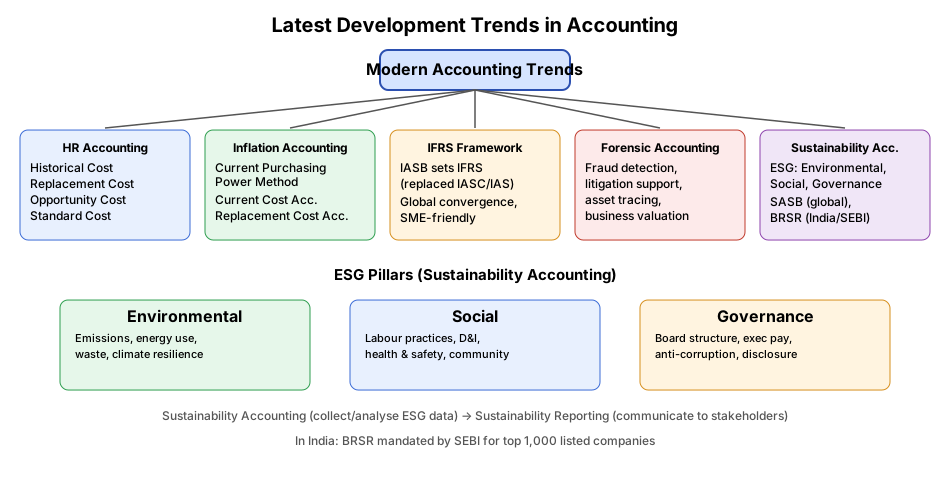
BRSR (India): Business Responsibility and Sustainability Report, mandated by SEBI for top 1,000 listed companies.
🧠 Memory trick for the 5 trend topics — "Happy Investors Follow Financial Stories": HRA, Inflation Accounting, Forensic Accounting, IFRS (International Financial Reporting), Sustainability Accounting.
Quick-Revision Table — All 5 Trend Topics
| Topic | Key Body/Standard | One-line Purpose |
|---|---|---|
| HRA | ICAI Guidance Note | Value employees as assets |
| Inflation Accounting | — | Adjust for price-level changes |
| IFRS | IASB / IFRS Foundation | Global accounting convergence |
| Forensic Accounting | — | Detect/investigate fraud, support litigation |
| Sustainability Accounting | SASB (global), BRSR/SEBI (India) | Report ESG impact |
Long-Answer Questions (15 Marks — model answers, ~300 words each)
Q1. Explain Human Resource Accounting (HRA) and its four methods of valuation. Human Resource Accounting is the process of identifying, measuring, and reporting the value of an organisation's human resources — its employees — as an asset, something traditional financial accounting ignores despite people often being a company's most valuable resource. HRA aims to help management treat people as a resource to be developed and utilised efficiently, support HR decisions around acquisition, development, and retention, report the cost and value of human capital to stakeholders, evaluate the return generated from investment in people, and provide financiers with a fuller picture of the organisation's true worth. Four principal methods are used to value human resources. The Historical Cost Method capitalises the actual costs incurred in recruiting, selecting, hiring, and training an employee, and writes this off over the employee's expected useful service life — simple and objective, but ignores the employee's current or future value. The Replacement Cost Method values an employee at what it would cost to replace them today with someone of equivalent skill and experience, covering both individual replacement cost (recruitment, training) and positional replacement cost (cost of filling that specific role) — more realistic but harder to estimate objectively. The Opportunity Cost Method values an employee based on what their skills would be worth in their next-best alternative use, essentially a competitive-bidding value — but it is only meaningful for scarce, high-value talent and impractical to apply organisation-wide. The Standard Cost Method groups employees into categories (e.g., by grade or function) and assigns a standard cost per category based on average recruitment, training, and development costs for that group, simplifying valuation across a large workforce. Each method involves trade-offs between objectivity, practicality, and how well it reflects an employee's true economic value, which is why HRA — despite being conceptually important — remains more of a supplementary disclosure than a mainstream item on the balance sheet.
Q2. What is Inflation Accounting? Explain any two of its methods. Inflation Accounting, also called Price Level Accounting, is a technique that adjusts financial statements to reflect the effects of changing purchasing power of money over time, addressing a key limitation of conventional historical-cost accounting — namely, that historical costs recorded years ago no longer reflect current economic reality once inflation has eroded the currency's value, distorting profit measurement and asset valuation. Two commonly discussed methods are Current Purchasing Power (CPP) and Current Cost Accounting (CCA). Under the Current Purchasing Power (CPP) Method, historical financial statement figures are restated using a general price index (like a Consumer/Wholesale Price Index) to express them in terms of current purchasing power — monetary items (cash, receivables, payables) are not restated since they are already stated in current rupee terms, but non-monetary items (fixed assets, inventory, share capital) are restated by applying the ratio of the price index at the current date to the price index at the date of acquisition. This produces a profit figure that accounts for the general loss of purchasing power, giving a more realistic view of real economic performance rather than merely nominal growth. Under the Current Cost Accounting (CCA) Method, assets and costs are shown at their current replacement cost rather than their original historical cost — for example, inventory consumed is charged to the P&L at its cost to replace today, not what was originally paid, and depreciation is calculated on the current replacement cost of fixed assets rather than their original cost. This gives management a clearer view of whether the business is generating enough profit to actually replace its productive capacity, which historical-cost profit figures can mask during high inflation. Both methods aim to prevent companies from unknowingly eroding their real capital base while reporting apparently healthy nominal profits.
Q3. Explain the role of the IASB and the IFRS Framework in achieving global accounting convergence. The International Accounting Standards Board (IASB), established in 2001, is the independent standard-setting body responsible for developing and issuing International Financial Reporting Standards (IFRS) — it succeeded the earlier International Accounting Standards Committee (IASC), whose standards (still referenced as "IAS," e.g., IAS 1 Presentation of Financial Statements, IAS 2 Inventories, IAS 16 Property, Plant and Equipment) continue to apply alongside newer IFRS-numbered standards (e.g., IFRS 9 Financial Instruments, IFRS 15 Revenue from Contracts with Customers, IFRS 16 Leases) until superseded. The IASB operates under the oversight of the IFRS Foundation, an independent, not-for-profit organisation whose stated mission is to develop a single set of high-quality, understandable, enforceable, and globally accepted financial reporting standards — including a simplified IFRS for SMEs to make adoption feasible for smaller entities and standards tailored to the needs of emerging economies. The core objective of this convergence effort is to eliminate the confusing patchwork of country-specific accounting rules that previously made it difficult to compare companies across borders, raised the cost of cross-border capital raising, and reduced investor confidence in unfamiliar accounting regimes. As more countries either fully adopt IFRS or converge their local standards with it (as India has done through Ind AS, which is substantially converged with IFRS with certain carve-outs for local regulatory needs), multinational investors, lenders, and analysts can compare financial statements from companies in different jurisdictions on a genuinely like-for-like basis, lowering the cost of capital for companies and improving capital allocation efficiency globally. This convergence movement also emphasises fair value measurement (particularly for financial instruments) over pure historical cost, reflecting a broader shift toward accounting information that is more decision-useful and reflective of current economic reality — a trend closely linked to the inflation accounting concepts discussed above.
Q4. What is Forensic Accounting? Discuss its nature, applications, and limitations. Forensic Accounting is a specialised branch of accounting that combines accounting knowledge, auditing techniques, investigative skills, and legal understanding to detect financial fraud, misconduct, and disputes, and to present findings in a manner that is legally admissible in court or before regulatory bodies. Its nature is distinctly multidisciplinary — a forensic accountant must understand not just accounting standards but also legal procedure, evidence-handling requirements, and investigative methodology — and it is both reactive (detecting fraud that has already occurred, such as embezzlement or financial statement manipulation) and proactive (designing and testing internal controls to prevent fraud before it happens). It also frequently involves litigation support, where the forensic accountant serves as an expert witness or prepares damage-quantification reports for legal proceedings. Its applications span a wide range of scenarios: valuing businesses and assets in bankruptcy or insolvency proceedings; conducting computer forensics to trace digital evidence of fraud (deleted files, suspicious transaction logs); calculating economic damages in commercial disputes (lost profits, breach of contract); tracing and dividing assets in family law matters like divorce or inheritance disputes; investigating financial statement misrepresentation (revenue inflation, expense concealment) for regulators or auditors; and conducting broader fraud prevention and response engagements for organisations, including designing whistleblower and internal control systems. Despite its value, Forensic Accounting has real limitations: engagements are typically costly and time-consuming, given the depth of investigation required; the work is inherently complex, often requiring reconstruction of records across multiple systems and years; conclusions can be subjective, since professional judgment varies between practitioners on ambiguous evidence; investigations raise privacy concerns, particularly when examining personal financial records or private communications; and a forensic engagement's scope is usually narrowly defined to the specific matter under investigation, meaning it may not surface broader systemic issues within an organisation beyond the immediate question being examined.
Q5. Define Sustainability Accounting and distinguish it from Sustainability Reporting. Explain the ESG framework. Sustainability Accounting is the process of identifying, measuring, and analysing an organisation's non-financial impacts — specifically its Environmental, Social, and Governance (ESG) performance — using a structured, often quantifiable approach, guided globally by standards such as the Sustainability Accounting Standards Board (SASB) and, in India, by SEBI's Business Responsibility and Sustainability Report (BRSR) framework mandated for the top 1,000 listed companies. It is important to distinguish Sustainability Accounting from Sustainability Reporting: Accounting is the internal process of collecting, measuring, and analysing ESG-related data (e.g., tracking carbon emissions, water usage, employee diversity metrics, board composition) — it is analogous to how financial accounting captures raw transactional data. Reporting, in contrast, is the subsequent process of communicating that analysed data to external stakeholders — investors, regulators, customers, and the public — in a structured, often standardised disclosure format, analogous to how financial statements communicate financial accounting data outward. The substance of what gets communicated is organised around the ESG Framework, its three pillars. The Environmental pillar covers a company's impact on the natural world — greenhouse gas emissions, energy consumption, waste management, water usage, and resilience to climate-related risks. The Social pillar covers how a company manages relationships with people — labour practices and working conditions, diversity and inclusion, employee health and safety, and its broader relationship with the communities in which it operates. The Governance pillar covers the structures and practices that ensure a company is run responsibly and accountably — board composition and independence, executive compensation alignment with performance, anti-corruption policies, and the quality and transparency of corporate disclosures generally. Together, ESG reporting has moved from a voluntary, reputation-driven exercise to an increasingly regulated requirement (as with India's BRSR), reflecting growing recognition that a company's long-term financial sustainability is inseparable from its environmental and social sustainability.